- publication
- Symposium on Vision, Modeling and Visualization (VMV) 2026
- authors
- Philipp Gerstner, Tanguy Magne, Olga Sorkine-Hornung
- award
- Best Paper Award at VMV 2026
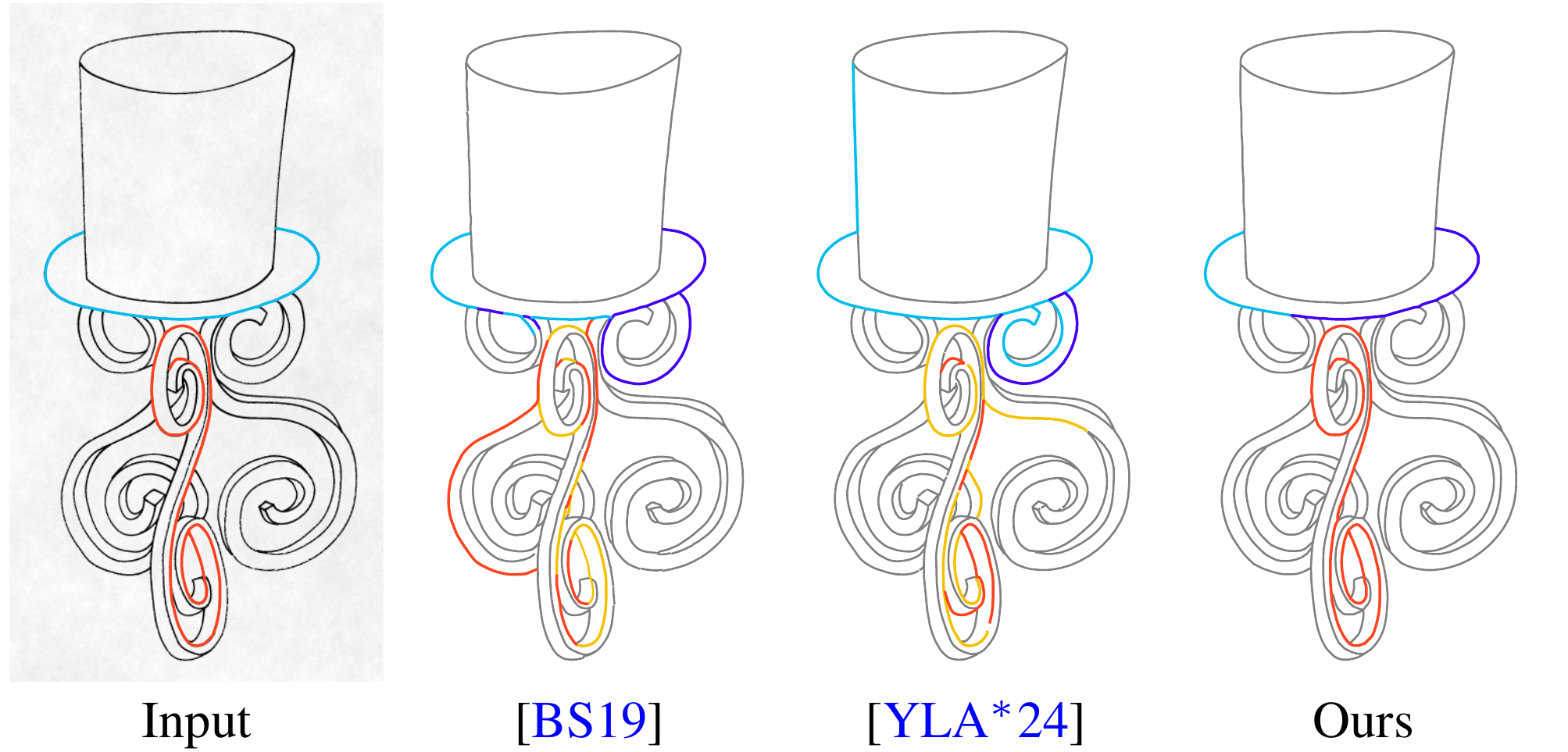
A raster image (left) vectorized using Bessmeltsev et al. (middle left), Yan et al. (middle right) and our method (right). Selected strokes are colored to highlight stroke routing. Our method produces strokes that closest match the original artist's intent.
abstract
Line drawing vectorization converts raster sketches into editable curves and is widely used in animation, illustration and design. A high-quality vectorization must preserve not only the visual appearance of the drawing but also its topology: the individual strokes, their endpoints and the way they connect at intersections. At junctions, existing methods often produce noisy geometry and misrouted branches, reducing the drawing to a collection of short segments, rather than a faithful representation of the original drawing. We propose a vectorization pipeline that separates the recovery of drawing geometry from stroke routing. A learned image-to-image model first predicts a centerline representation of the drawing, from which a planar straight-line graph with single-vertex junctions is built. A second learned model then predicts for each junction the incident branches that continue through it as a single stroke. We formulate this routing decision as the prediction of an involution on half-branches, allowing it to be made jointly over the entire drawing. On a benchmark of 369 professional line drawings, our pipeline recovers substantially more ground-truth intersections and produces fewer oversegmented strokes than four prior baselines, while remaining competitive on standard geometric metrics. By recovering the correct topology, our method yields results that are visually more appealing and easier to edit.
downloads
acknowledgments
We thank the anonymous reviewers for their careful reading and valuable comments.